Showing posts with label [3/10] Mildly entertaining but not compelling.. Show all posts

Thursday, November 29, 2018

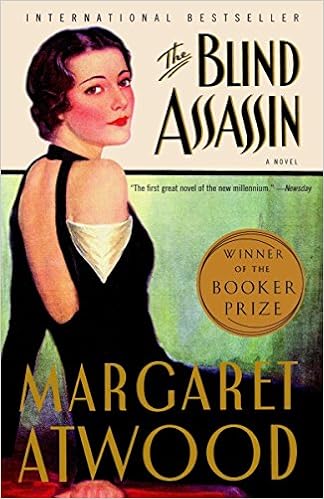
63. The Blind Assassin - Margaret Atwood

After a long absence, I am back, ready to add a few more reviews to this project! I started with a book that I have long admired the cover of in libraries. It seemed so full of promise, but I must say, I left feeling disappointed.

Image result for the blind assassin

My overall impression after reading this book was one of tarnish - a kind of dingy grubbiness. A feeling that nothing would ever shine out, bright and true and beautiful, because everything is seen through a lens of inevitable loss and disappointment.
I've looked back over what I've set down so far, and it seems inadequate. Perhaps there is too much frivolity in it, or too many things that might be taken for frivolity. A lot of clothes, the styles and colours outmoded now, shed butterflies' wings. A lot of dinners, not always very good ones. Breakfasts, picnics, ocean voyages, costume balls, newspapers, boating on the river. Such items do not assort very well with tragedy. But in life, a tragedy is not one long scream. It includes everything that led up to it. Hour after trivial hour, day after day, year after year, and then the sudden moment: the knife stab, the shell-burst, the plummet of a car from a bridge.
The novel begins with the death of Laura, the narrator's sister, in the car crash mentioned above, and is told by the narrator towards the very end of her much longer life as she looks back and remembers the details leading up to the great tragedies in her life.

I did become quite fond of Iris as a narrator, and the story held my attention, but in many ways I couldn't wait for it to be over so I could move onto something less... wearisomely sepia, less wrapped up in the sense of decay. The story line is very clever, in its interweaving of narratives within narratives, and the ending is at the same time surprising and not surprising at all - kind of glimpsed through a dreary veil - the combined effect of the rheum of old age and the smudged deception of unrealised dreams.
I wonder which is preferable - to walk around all your life swollen up with your own secrets until you burst from the pressure of them, or to have them sucked out of you, every paragraph, every sentence, every word of them, so at the end you're depleted of all that was once as precious to you as hoarded gold, as close to you as your skin - everything that was of the deepest importance to you, everything that made you cringe and wish to conceal, everything that belonged to you alone - and must spend the rest of your days like an empty sack flapping in the wind, an empty sack branded with a bright flourescent label, so that everyone will know what sort of secrets used to be inside you.
It was a relatively easy read and I am not sorry that I read it - but I won't be reaching for it again.

Wednesday, April 04, 2012

52. The Devil and Miss Prym – Paulo Coelho


This book would be an interesting companion piece for high-school students to read beside Nathaniel Hawthorne's The Scarlet Letter...

A stranger arrives in an isolated mountain village and makes an astounding offer: a fortune in gold for every resident if someone - anyone - in the town is murdered within a week! The outcome will answer the question - are people inherently good, or inherently evil?

You can imagine the chaos that ensues... first inside Miss Prym, the barmaid to whom the offer is first revealed. Should she just forget she ever heard such a deal? Should she dig up some of the gold, and run away from her dead-end life? Should she trust her friends to do the right thing... or is she rightfully afraid of the mob-mentality?

It's a short and simple story, easy to speed through, but worthy of stopping to consider its after effects. The ultimate answer is that there is no answer - there is no inherent good or evil in humanity, it is all a matter of individual choice. We are all tempted by evil. The issue is whether we are prepared to struggle against it.
"It was all a matter of control. And choice. Nothing more and nothing less."

Each person has their own demon and angel on their shoulder... who will they listen to?
It is a novel full of cliches - the old story about the man who dies on a journey and doesn't realise he is dead, suffers horribly from thirst but refuses to enter the first gate with the lovely fountain, as his animal friends aren't allowed, continues on to the second gate where all are welcome and finds that this is heaven - the first gate being hell, which weeds out anyone who would slake their own thirst while leaving their faithful companions to suffer... the story of Midas who wished to turn everything he touched into gold and ended up regretting the result...

The townspeople decide they will drug and shoot a crazy old woman whom nobody will miss... they'll make it a Russian roulette so no one individual will bear responsibility... they are all gung ho and ready to go... but then Miss Prym raises some financial realities. How are they going to convert the gold into modern currency? The bank will want to ask questions about where it came from, how they got it... will they trust each other to keep the secret of their shame? The risk is too great, they can't trust each other, and so good prevails overall - through cowardice if not through conviction.

In many ways, the novel is unsatisfying, for the one-dimensionality of its characters, for the way in which the narrative skips around from one to another without much sense of direction, the archetypal, allegorical aim that was just a bit too obvious... the ending which just fizzled away into nowhere (Miss Prym gets to start a new life with the gold, the villagers must pay for Berta's fountain after all, but nothing is really answered, no-one has really changed)... meh. The premise was good, but I think it lost something in translation.

The only character I really liked was old Berta, the victim chosen by the townspeople, sitting on her doorstep chatting with her long-dead husband, and waiting for the devil to arrive.
Berta was watching the sun setting behind the mountains when she saw the priest and three other men coming towards her. She felt sad for three reasons: she knew her time had come; her husband had not appeared to console her (perhaps because he was afraid of what he would hear, or ashamed of his own inability to save her); and she realised that the money she had saved would end up in the hands of the shareholders of the bank where she had deposited it, since she had not had time to withdraw it and burn it.
She felt happy for two reasons: she was finally going to be reunited with her husband, who was doubtless, at that moment, out and about with Miss Prym's grandmoth er; and although the last day of her life had been cold, it had been filled with sunlight - not everyone had the good fortune to leave the world with such a beautiful memory of it.
The priest signalled to the other men to stay back, and he went forward on his own to
greet her.
'Good evening,' she said. 'See how great God is to have made the world so beautiful.'
'They're going to take me away,' she told herself, 'but I will leave them with all the world's guilt to carry on their shoulders.'

Thursday, August 16, 2007

2. Saturday - Ian McEwan


This novel continues in the footsteps of Virginia Woolf's Mrs Dalloway and James Joyce's Ulysses by encapsulating a single day in the life of its main character - in this case, a British neurosurgeon named Henry Perowne.

The edition I picked up from the library had 4 pages of "international praise" at the start of the book - quotes from many reviewers lauding the brilliance of McEwan's writing. It is certainly an achievement which any aspiring writer may envy and desire to emulate. A quick and easy read, it kept me turning the pages quite contentendly, but it somehow lacked that dazzling quality which would inspire me to want to read it again.

Perowne is generally an attractive and likeable, though somewhat apologetic character, and the action centres around him preparing for a small family reunion on a day when London is brought to a standstill by an immense peace demonstration against the war in Iraq.

Most of the novel's themes are summed up in the following passage, which takes place as Perowne chooses fish for the stew he plans to make that evening.

"He turns the corner into Paddington Street and stoops in front of the open-air display of fish on a steeply raked slab of white marble. He sees at a glance that everything he needs is here. Such abundance from the emptying seas. On the tiled floor by the open doorway, piled in two wooden crates like rusting industrial rejects, are the crabs and lobsters, and in the tangle of warlike body parts there is discernible movement. On their pincers they're wearing funereal black bands. It's fortunate for the fishmonger and his customers that sea creatures are not adapted to make use of sound waves and have no voice. Otherwise there'd be howling from those crates. Even the silence among the softly stirring crowd is troubling. He turns his gaze away, towards the bloodless white flesh, and eviscerated silver forms with their unaccusing stare, and the deep-sea fish arranged in handy overlapping steaks of innocent pink, like cardboard pages of a baby's first book. Naturally, Perowne the fly-fisherman has seen the recent literature: scores of polymodal nociceptor sites just like ours in the head and neck of rainbow trout. It was once convenient to think biblically, to believe we're surrounded for our benefit by edible automata on land and sea. Now it turns out that even fish feel pain. This is the growing complication of the modern condition, the expanding circle of moral sympathy. Not only distant people are our brothers and sisters, but foxes too, and laboratory mice, and now the fish. Perowne goes on catching and eating them, and though he'd never drop a live lobster into boiling water, he's prepared to order one in a restaurant. The trick, as always, the key to human success and domination, is to be selective in your mercies. For all the discerning talk, it's the close at hand, the visible that exerts the overpowering force. And what you don't see... That's why in gentle Marylebone the world seems so entirely at peace." (p 127)

This is not an environmental novel - and from memory, these fish are the only animals mentioned - but the ways in which human perceptions of our place in the universe have changed, the way in which world events and moral reactions to them are viewed broadly, ambiguously and with only partial understanding, and then narrowed to the realm of immediate individual decisions on how to act and think, how decisions are coloured by personality how they change and develop as events impact upon the characters - these concerns are typical of the novel as a whole.

Perowne is most human in his interactions with his family - his busy lawyer wife Rosalind, his poet daughter Daisy, and blues-singing son Theo. Poetry actually plays a major role in the novel - though Perowne has limited literary tastes, his cantankerous father-in-law is a published poet and his daughter has just had her first volume published. Perowne struggles to understand the fascination and is more interested in what Daisy's poems seem to reveal about her life away from the family. He forces himself to try and understand the art, both for her sake and because he worries he might have missed something worthwhile in his single-minded focus on a medical career.

"Novels and movies, being restlessly modern, propel you forwards or backwards through time, through days, years or even generations. But to do its noticing and judging, poetry balances itself on the pinprick of a moment. Slowing down, stopping yourself completely, to read and understand a poem is like trying to acquire an old-fashioned skill like drystone walling or trout tickling." (p129)

Poetry and literature and music are another element, just as the water was for Perowne's mother (a champion swimmer), or the physical structure of the human brain is for Perowne himself. There is a kind of escapist challenge in being able to immerse yourself in this 'other', abandoning your personality and temporarily forgetting the wash of events going on around you.

The only real action in the novel centers around a street thug named Baxter. Perowne narrowly escapes a violent confrontation with him by accurately diagnosing his medical condition, and the encounter leaves him physically and mentally uncomfortable for the rest of the day. That evening, when the family is finally gathered together, Baxter invades their home. There is potential for disaster, for Perowne's comfortable, luxurious world to be ripped apart, but in the end it is only Baxter who really gets hurt. Perowne assuages his guilt (feeling he should have handled the original altercation better) by operating to save Baxter's life, in the process deciding to forgive him and ensure he lives the rest of his short life expectancy with proper institutionalised care.

The turning point in the home invasion comes when Daisy, naked and vulnerable, quotes Mathew Arnold's poem 'Dover Beach' to Baxter (he had demanded she read something of her own from her book). I found this the most unconvincing moment of the story, perhaps because that poem has never been one that spoke to me.

"Daisy recited a poem that cast a spell on one man. Perhaps any poem would have done the trick, and thrown the switch on a sudden mood change. Still, Baxter fell for the magic, he was transfixed by it, and he was reminded how much he wanted to live. No one can forgive him the use of the knife. But Baxter heard what Henry never has, and probably never will, despite all Daisy's attempts to educate him." (p278)

Poetry, music, good food and wine - a comfortable existence transposed on a world of turmoil, of vaguely troubling thoughts and doubts about terrorism, war and genocide. At the end of the novel, Perowne stands at his window looking out at the pre-dawn, just as he did at the beginning, only now he thinks about what a doctor standing there a hundred years ago might have thought, about how lifestyles and expectations have changed over time. The novel was first published in 2005, but already it feels rather dated. I would be surprised if it endured to be a classic read in the next century.